
by Nanny Aut
I am going to preface this by saying this is not a ‘Autistics stem from Neandrathals’ discussion.
My knowledge of genealogy and archeology is far too limited for that. There would likely be huge factual errors if I did that.
This is more musings based on Darwin’s observation of finches in the Galapagos.
He noted that while all these birds were genetically finches, they had modified to adapt to their environment – different lifestyles, different outward appearances.
It is this lens I am using to look at why autistics / ADHDers may be different to the neuromajority.
If we imagine in the way back when, humanoids adopted two different lifestyles based on their environment.
One group became settlers, finding an area that would support them year round, which would allow for farming, which would support very large groups of people living together. Imagine these people evolved into what we now know as the neuromajority.
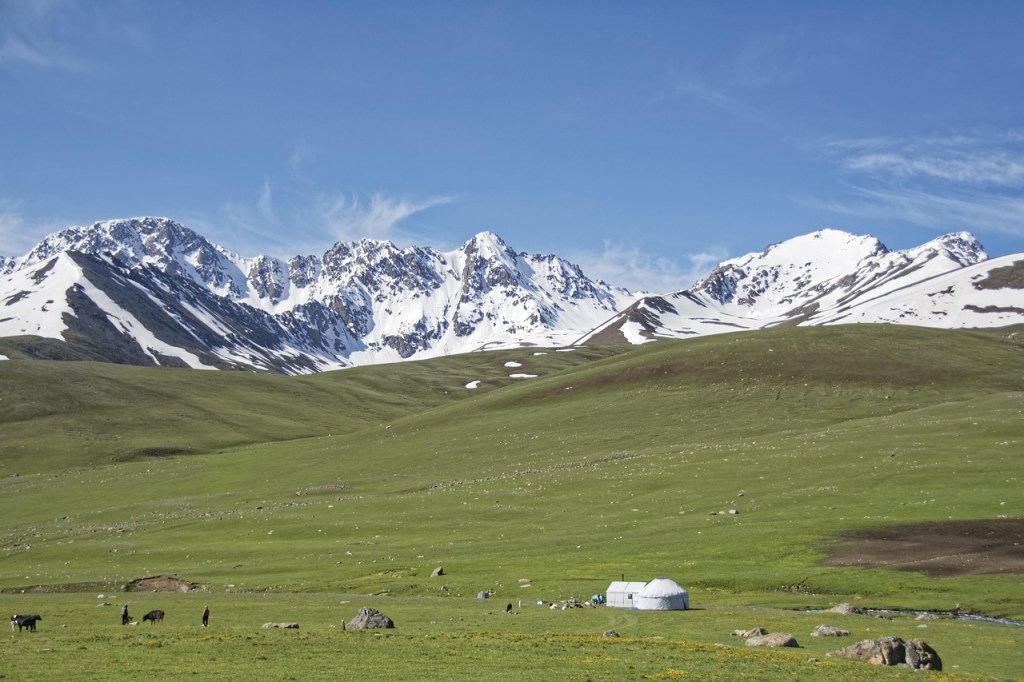
One group became nomads, travelling from area to area according to the season and resources, needing to remain in small groups to not exhaust naturally occurring resources. Imagine this group evolved into the group we now know as autistics / ADHDers.
The settler group no longer needed to worry about resource hunting or predators. Only if you were on the edge of the group or excluded from the group would that be an issue. Predators would only pick off the weak on the edges. Resources were plentiful enough to be shared.
So the only things you had to be on the alert for was social interaction – you didn’t want to be the one thrown to the wolves (literally) or left to starve if resources became more limited. And strangers – strangers could invade, take resources, bring disease, even collapse the social construct completely. They were a serious threat.
You would also need hierarchy and other social constructs in order to stop the community turning on itself. Chaos would ensue if you had a thousand people all making their own decisions, particularly when those decisions are led by self-interest. So leaders emerge, and key decisions devolve on them, not the individual in the group. Leadership isn’t necessarily based on expertise, but on dominance – those who can get the majority to follow their lead.
Individual decision making is now much less important, key decisions are made from above, day to day decisions can rely on the predictability of life. Your brain can save a lot of energy by not thinking decisions through, defaulting to a binary of yes/no based on past events.
Your brain can save a lot of energy by reducing the amount of things you pay attention to. Living in a large community there is a LOT of input going on, thousands of people – emotions, smells, noise, movement. Too much for a human brain to handle, it would overload daily.
And most are not relevant to your survival. No predators or resources to worry about. Only social interaction impacts your welfare. Which makes it safe for the brain to install a filter limiting input to seven to nine items. Essential even, in order to prevent regular overloads.
With this filter in place it becomes easy to identify what is important to you and what isn’t – you only have six or seven items to evaluate.
You also need to switch off emotional mirroring in a large community – it’s almost impossible to function if you are feeling all the emotions of all the people around you as well as your own. A new method of reading emotions is needed – tone, facial expressions, body language.
Your survival senses of sight, sound and smell no longer need to be heightened, which gives space for interoceptive and proprioceptive senses to become more prominent. Your sensory profile flattens out to a middle ground.
As social structure is communally agreed, you end up being surrounded by people who think like you, share your world view, share your language, share your customs. Who build a consensus of understanding you term ‘common sense’. Coding and shorthand becomes standardised. Those around you are easy to predict and understand. Deep connection and relying on a few is less desirable than surrounding yourself with many. The bigger the group around you, the better your survival chances.
It becomes better to become useful at a number of things to avoid being discarded by the group if your particular skill becomes redundant. Better to be a generalist than a specialist. Better to be able to handle multiple tasks simultaneously than focusing intently on just one. And easier to do this because you only have six or seven strands to pick from, not hundreds.
Disruptors are viewed with discomfort because that then requires the security of current thought patterns to be revised. Volume of labour, all working to the same pattern works better than individuality. group working trumps expertise. One person knowing better than the group can turn everything upside-down unless they are already the leader.
Then you have the nomads, where almost none of this holds true.
The group has to remain small because you’re relying on found resources, not farmed resources. This means our survival depends on being fully alert to everything around you. Paying attention to everything, everywhere, all at once. Watching out for the predator who might sneak up, for the resources that may be hard to spot.
Trust in your group is implicit – if that predator comes, unless you hold together, the predator can pick all of you off one by one. Sharing resources is essential to survival because any one of the group could spot the next resource. If you hoard this time, you will be excluded the next time. Losing a member of the group weakens the whole group.
This makes social interaction rules redundant – your survival doesn’t rely on your place in the group. Strangers are a valuable asset, with new information about places you hadn’t visited. Immunity to disease is higher because exposure to multiple other groups is part of the wandering lifestyle. As opposed to large communities who travel nowhere and see no-one new.
Hierarchy, as such, is based on expertise. The group is too small to have multiple experts in each area. Each individual brings their skill to the mix.
Each individual needs to be good at decision making – and with the environment always changing, you can’t rely on predictability to do the heavy lifting. You need to review all the data you have, past and present and calculate out potential outcomes based on that data before selecting the best one. To optimise this, you become excellent at pattern spotting.
Your brain also can’t save energy by placing in a filter – you would miss both predators and resources. Which means you need to find other ways to reduce overload and to identify what is important. You become a specialist not a generalist, elevating one particular skill, relying on other people’s skills to fill in your gaps. Now you can focus on one thing and things not related to your skill can be ignored as irrelevant.
Emotional mirroring is an essential tool to connect with others. It means you can pick up alerts – surges in anxiety or excitement – without the need for vocalisation or looking directly at the individual. It also allows you to engage with strangers, reflecting back their emotional energy.
Body language and vocal tone, on the other hand, are not particularly useful.
Your survival senses need to be switched to high to give you as much advance warning as possible. Senses that may be less relevant can get put on mute. No point in knowing if you are hungry or thirsty if there isn’t a resource nearby. No point in needing to know in advance if you need to go to the bathroom with a whole wilderness at your disposal. Knowing you’re injured in the middle of a fight isn’t helpful – it distracts from the job in hand. That signal can happen later when it’s quiet.
You rely on the fact that no one thinks like you, that it’s impossible to predict someone else’s thoughts. Communication needs to be direct and clear, not shrouded in hints and guesswork.
The world is a combination of predictability and uncertainty. You need to hold onto what CAN be predicted, in order to give you the processing capacity to manage the unexpected.
Each unexpected situation is a potential threat to be assessed and analysed – all information is used because you can’t be certain what is relevant and what is not. This can lead to novel solutions that others might not have considered. This makes you a default disruptor.
Sadly, the nomadic life is rare now – settlers occupied the spaces where we walked, eradicated us as invaders or captured us as forced labour. Settlers saw their way of life as superior and used this to justify the subjugation and exploitation of those they saw as less than.
Saw nomadics as defective, lacking the skills to cope well in large communities.
Viewed nomadics with distrust, despite assimilation, saw us as invaders, disruptors, unsafe. The ones to throw to the predators when under attack. The ones to leave to starve if food runs scarce.
Despite this we survived, married in, or bred amongst ourselves. Even in some cases, managed to recreate the environments we thrive in.
Which brings us to now – different neurotypes living together, with the neuromajority still insisting their neurotype is somehow superior. Still distrusting us, still throwing us to the wolves (no longer literally) when under threat, still only willing to engage if they can exploit us.
OK – that last bit sounds a little bitter and judgemental, but that is exactly what it can feel like when you’re autistic or are ADHD. Whether or not the neuromajority intend it, or even realise that’s what they are doing.
This world IS big enough for the both of us, and we both bring strengths and weaknesses to the table. To see that fully realised needs co-operation not domination.


This is really helpful, thanks!
LikeLiked by 1 person
I found this a really interesting read. I’m AuDHD and did a PhD studying the transition from hunter-gathering to agriculture – no-one still is entirely sure why it happened – so it really struck home to be. I think it makes a lot of sense.
LikeLiked by 1 person
I agree Jenny. I’m AuDHD too and my interests change constantly. I wonder if this is a nomadic thing- learning how to do something then moving to something else, so we learn lots of skills that are useful to our ‘tribe.’
LikeLike