
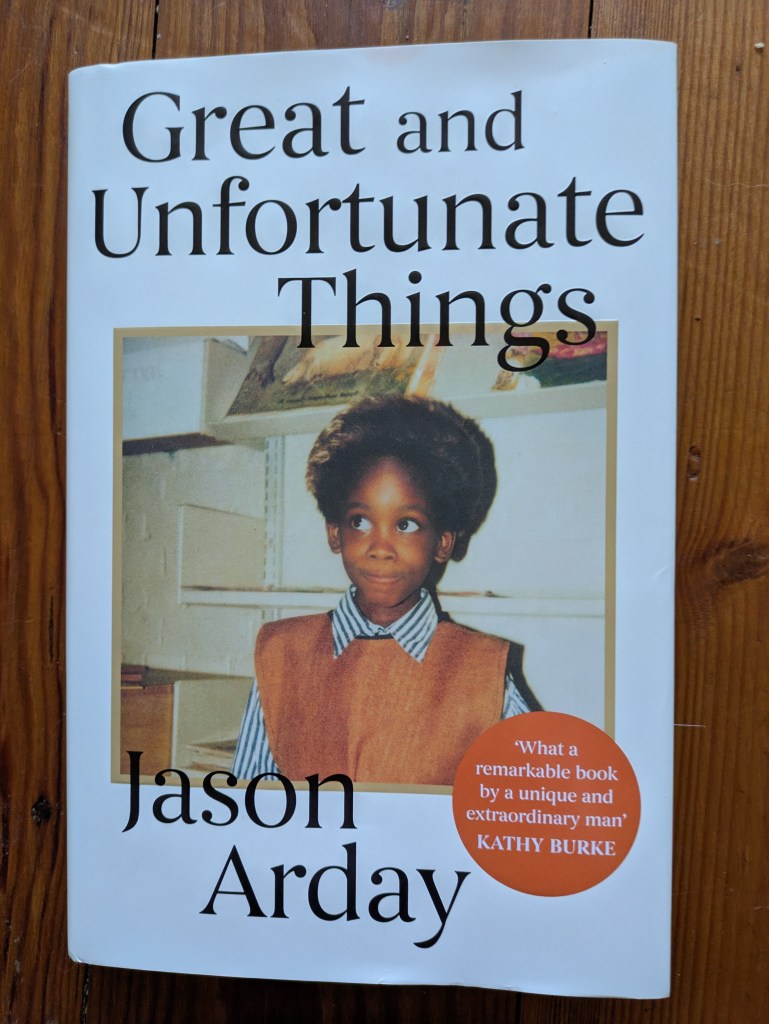
By Nanny Aut
There are many terrible things about the hounding of Professor Arday and the determined way that the Press portrayed him as a liar. One of these is the way that invalidates the contents of this book for many people.
And this book should not be dismissed or invalidated.
It not only speaks strongly to the autistic experience of many, including myself, it also talks about what it’s like to grow up non-verbal – truly non-verbal not non-speaking. It offers a lived experience insight into a community of autistics we rarely get to hear from.
While there are a growing body of non-speakers who are now talking about their experience such as Danny Whitty, Gregory Tino, Ben Breaux and Sabrina Guerra, to name just a few, this is the first I have come across who talks about their experience of moving from non-verbal (without words) to being verbal (with words). Indeed, up to this point I had falsely assumed that non-verbal was simply a dismissive term for non-speakers – to say there was no point in teaching alternative communication methods.
And that lived experience matters. It shouldn’t be discounted and dismissed because the press chose to paint Professor Arday as a fantasist. Professor Arday’s conversation about his time without words has a lot of resonance with those of us who do have words, but for whom words are a second language, not our primary one.
And it could provide an avenue for research into why some of us, who primarily think in shape, pattern and physical experience quickly make the connection between our experience and words to express it and why some take more time, and why some never make the connection at all.
From this book, it seems a key avenue to explore is interest and an active effort to connect with the world of the non-verbal person. To use core experiences such as the very sensory rich experience of biting an apple to link key words to, in this case ‘Bite the apple’.
Jason speaks to years of wasted time in therapy forcing Jason to do things he wasn’t interested in, to use words he had zero connection to, went precisely nowhere. The only thing all that time did was teach him some extremely unhealthy coping habits. He talks about the gamechanger being Giff, his Mum, his safe person, who believed there was a way despite all the professionals told her. Who observed him, engaged with him, met him where he was at. Not stopping his behaviours but redirecting if harmful. Such as providing a cushion for headbanging and switching toothpaste for faeces (toothpaste has a very similar handfeel and meets the same sensory need without the hygiene issue).
His Mum may have known nothing about monotropism, or how autistics learn best and make connections best when information is linked to our superhighway – knowledge built from our deep interests. It didn’t matter because she figured out the way to connect with her son, to meet him where he was at instead of trying to move him to where he wasn’t. She also treated all her children as individuals, as human beings with their own experiences, their own challenges and their own way of doing things. And she had patience. Years of connection, years of exposure to things she believed would engage and interest. Not giving up because there wasn’t instant success. Continuously talking with him, despite there being zero evidence of comprehension. Having an innate faith that eventually the penny would drop.
And she was a safe space for Jason – often his ONLY safe space in those early years. The outside world was alien, overwhelming, even downright hostile. And that safe space is crucial to learning and making new connections.
Jason’s book also talks a lot about the power of belief. Those that believed in him put in the work to provide effective support, were curious about the barriers, assumed he could learn. And that work made a huge difference. Becoming verbal. Learning to read and write. Learning to take responsibility for himself. Learning to challenge limitations set by others.
It also talks a lot about the power of disbelief – those that wrote him off, didn’t bother, didn’t engage. Who ignored the fact he couldn’t read or write, who were ok with his skipping school, who isolated him and left him to his own devices. Resulting in so many wasted years. Leaving school with minimal qualifications that relied on practical assignments rather than written work, unaware at the time he was both dyslexic and dyscalculic.
He speaks to a school system that offered terrible choices – Special Education where children were babysat, not educated – something His Mum fought hard against – and Mainstream where teachers were already overloaded and completely untrained in providing support for any student with additional needs. And one magical moment where there WAS council funding provided for an active support within Mainstream – only for it to be taken away due to budget cuts.
And from working on the Barriers to Education project and reading the responses from the survey we did – little has changed.
Jason freely admits that his routes to success were not down to him, but those who engaged with him and provided the avenues to escape and to dream bigger. That he could easily have spent his life struggling with basic low level jobs that allowed for him to be illiterate. He had accepted at eighteen that learning to read and write was an impossibility for him. A source of shame, but unchangeable. It took someone else, who understood how to teach him to change that.
Jason also talk a lot about two key traits that are deeply resonant for many autistics. Monotropism – that deep focus on something once it has engaged our interest – and the driving need for completion. That once we have set a goal, we will be driven to complete it, even if it’s to the detriment of our health and well-being. Even if we have no real idea, when we start, HOW we’re going to complete it. It is one of the reasons many of us fail to start anything at all. Because IF we start and fail to finish we know it is going to cause us deep visceral pain. Once we have stepped onto that course, we’re going to try to barrel through to the end. However long it takes, however many hits we take on route, however many false starts and fails occur.
This doesn’t apply to goals set by others, the oughts and shoulds of the world. Or the ‘It might be kinda cool if I did X’ goals. That drive for completion relates to targets set by us that feel internally important.
In Professor Arday’s case this comes up significantly three times.
The first, when he was small – coveting his Mum’s wedding wine glasses, to feel the satisfying snap between his fingers as he broke the stem. Watching and waiting for the opportunity, figuring out how to reach them. Finally acquiring the target and feeling the powerful joy of the sensory snap of the glass between his fingers.
The second, the marathon running 30 in 35 days, inspired by Suzy Izzard. The event mocked and ridiculed in the press as blatantly untrue, despite numerous articles on it at the time he did it. Reading about it in the book, it has the ring of truth for me – someone who was already fit, a keen footballer, who ran every day in order to regulate. Someone who was driven to make a difference and saw this as a way to fundraise. Who did spectacularly badly on the fundraising side as he lacked the executive functioning to effectively promote the event. But kept running anyway. Because he had started and needed to finish.
Luck and a PR firm who got involved changed the fundraising levels and public engagement. But it didn’t change his drive to finish, even after a hairline fracture which caused significant amounts of pain, and needed heavy doses of painkillers to get through it. The task wasn’t complete until thirty marathons were done. Full stop.
The third, his goal of being a professor at Cambridge. He knew this was unrealistic but was driven to work towards it anyway. Figuring out the steps he needed to do to get there. Getting a PhD in PE because that was where his current qualifications lay. Doing significant research by talking to other, mainly black, academics who were willing to share their insights on how to enter academe. And finding his deep passion in the process – what are the current barriers to academia based on race and neurodivergence and how to address that. Hello monotropism.
It was this monotropic focus on his new topic that led to writing the top quality journal articles that were noticed globally and not only led to his entry into the field of Sociology but to global speaking engagements. (Note – the comment about top quality articles is not from his book but from testimonials of those who have read them posted after his death.)
It was this track record of articles and speaking engagements that led to his being interviewed for the post at Cambridge. Definitely not his PE PhD, which would have counted against him, nor his marathon running (irrelevant to being a Professor). Whether he was hired on the grounds that he was a great press release for Cambridge to pretend they’re neither racist nor ableist is debatable. What I do know from my own years in academia and from the experience of colleagues who have been on both sides of the hiring panel, is that there’s usually only a sliver of difference in the quality of candidates being interviewed. That any one of the candidates at that stage of the process are a strong choice. That it’s the little things that can tip the balance one way or another. And a feelgood Press Release is not a little thing when tipping the scales between one strong candidate and another. What would NOT have happened is that a weak candidate made it to the interview round. Cambridge is fiercely protective of its reputation and would never have put itself in that position – no matter how good the Press Release.
The book speaks little to his body of work or even his work in Cambridge. It talks about the joy of being there and the sadness at the racist attacks that rumbled continuously throughout his time there. It speaks to the shock of becoming an overnight celebrity from the Cambridge Press Release, a release he’d been unaware was going to happen. It speaks to the power of the positive messages he received which were both a support and a burden. Support because it countered the negative behaviour from some colleagues, burden because there were far too many to answer.
My feeling after reading this book was deep grief for the loss of a human being, who had so much more insight to share. Who had a deep compassion for the world around him. Who wanted to leave the world in a better place than when he entered. Who was making a difference in the conversation about racism and ableism in the academic community. Possibly a key reason that the target was painted on his back. His work directly countered the anti-DEI narrative that seems to be growing in power right now. Discredit him, discredit his work by association.
He never painted himself as a hero in this story – that role he assigns to the people who helped him and believed in him, primarily his Mum, Giff. He does recount an extraordinary story, and at times extraordinary achievements – few get a Professorship at Cambridge, even fewer with a working class background, fewer still that aren’t white, and few that are openly neurodivergent (although I suspect a vast percentage are ND, simply undiagnosed). And he is unique in being a Professor who had been a non-verbal autistic and who only gained basic literacy skills at 18.
He speaks openly of his flaws and failings, how he let his wife and children down, how he was unable to adapt a route easily once he had set his mind on it. How he was unable to process large emotions after learning for so long he was unable to do so. He talks of struggle, pain, burnout, failure, success and joy as equal bedfellows in the journey of life.
In my personal opinion, this book deserves to be a Bestseller. Not because of who wrote it or what happened to him, but because of the way it speaks to autistic experience. It may be promoted as Inspoporn, a Rags to Riches story of succeeding against the odds, but it isn’t that.
For those that aren’t autistic – this is a glimpse inside our world. If you have any desire to understand us better, this should help.
For parents of non-verbal / non-speaking autistics, this book shouldn’t be seen as a beacon of unrealistic hope, as we all have our own path to follow, but speaks to the importance of acceptance and engagement over fixing and correcting.
For those that are autistic – this is a rare glimpse into the non-verbal world. And a book that talks about and normalises both the highs and lows of autistic experience. And it speaks to the power of belief and the need to find people who believe in us.
And we all need that.
For an article on my thoughts as to WHY people prefer to believe Professor Arday is a liar see this blog.


I am part way through the book. So many of the things Jadon says remind me of the wonderful children I worked with in my 40 years of teaching children with learning differences.
The articles and comments I have read elsewhere show such appalling ignorance and cruelty. Thank you Autistic Village for rectifying this.
LikeLike